Author Archives: Smile Essential

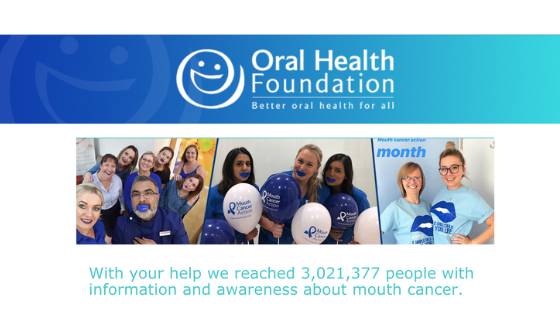
A special note from the Oral Health Foundation…

With your help we reached 3,021,377 people with information and awareness about mouth cancer.
  

To the thousands of you who supported us during Mouth Cancer Action Month – thank you. Your activities and events were truly inspiring and undoubtedly had an impact on how much people know about this truly terrible disease. 

At the Oral Health Foundation, we want to the get more mouth cancers diagnosed at an early stage by raising awareness of the disease while encouraging everybody to be more vigilant about changes in their mouth. 

As an entirely independent charity, the Oral Health Foundation relies on the generosity of its supporters to continue its mission and address the inequalities which exist in mouth cancer.

Our vision is to live in a world where nobody loses their live to mouth cancer. 

Your donation will support us in our year-round efforts improve the public’s knowledge of mouth cancer, allow us to provide even more advice and support while enabling us to continue our political work so that we can reduce those affected by mouth cancer while improving the quality of treatment and support in aftercare.  

If our work can save just one of the 2,700 lives that are lost to mouth cancer every year, then it is a more than worthy cause.

Visit www.dentalhealth.org to learn more about our campaigns and activities.

Mouth Ulcer Information…

Around 1 in 5 people will suffer from mouth ulcers at some point in their life and 17% of the population suffer from recurrent mouth ulcers. But what causes mouth ulcers? It may surprise you to know that the exact cause of mouth ulcers is still not known.

Most mouth ulcers are caused by things you can try to avoid, such as:

• Biting the inside of your cheek
• Badly fitting dentures, braces, rough fillings or a sharp tooth
• Cuts or burns while eating or drinking – for example, hard food or hot drinks
• Food intolerance or allergy
• Spicy foods
• Damaging your gums with a toothbrush or irritating toothpaste
• Feeling tired, stressed or anxious

The odd mouth ulcer is usually harmless and heals up on its own with the help of treatment. You should seek medical advice from a dentist or GP if you have a mouth ulcer that lasts for 3 weeks or longer or it keeps on coming back.

Occasionally cases of recurrent or complex mouth ulcers can be caused by an underlying health condition, such as an impaired immune system; nutritional problems, such as vitamin B-12, zinc, folic acid, or iron deficiency and gastrointestinal tract disease, such as Coeliac disease and Crohn’s disease.

Sometimes medications can cause mouth ulcers, if you notice a correlation between your medication and mouth ulcers then it’s important you continue with the medication but get checked out by your GP as soon as possible.

Pain from a mouth ulcer doesn’t usually require treatment however you can use over the counter remedies such as Bonjela which may help to relieve some of the discomfort temporarily. Pain from a mouth ulcer generally lessens in a few days and the sores usually heal without treatment in about a week or two.

If sores are large, painful or persistent, your dentist may prescribe an antimicrobial mouth rinse, a corticosteroid ointment, or a prescription or non-prescription solution to reduce the pain and irritation.

5 New Year Habits Your Oral Health Needs

1) Eat more fruit and vegetables

Having a healthy mouth has a lot to do with your diet. Even with the best oral hygiene routine (brushing twice a day, flossing once a day), it can still be hard to keep your teeth healthy over the long term if your diet isn’t right.

Eating a variety of nutrient-rich foods from all the food groups helps to promote healthy teeth and gums. This means to maintain a balanced diet of fruits, vegetables, protein foods, calcium-rich foods and whole grains for a healthy smile as well as a healthy body.

2) Stop smoking

We all know that smoking is bad for your health but you might be surprised to see the different ways in which it can affect your oral health:

These include:
• stained teeth
• bad breath (halitosis)
• tooth loss
• gum disease
• loss of taste and smell
• reduced blood supply to the mouth
• an increased build-up of plaque and tartar on your teeth
• delayed healing following dental extractions and other oral surgery
• increased risk of oral cancer

You can get further reading and advice on the by clicking here…

3) Change your toothbrush

A study looking at peoples oral health habits discovered that people were actually changing their toothbrush every 9 months. That’s 6 months longer than recommended. Your toothbrush is home to more than 100 million bacteria including E. coli and staphylococci (Staph) bacteria, according to researchers at the University of Manchester in England.

4) Reduce Stress

Stress can seriously affect your oral health if you are clenching or grinding your jaw/teeth. Teeth grinding is medically known as a condition called bruxism. Many people are often unaware they have this problem, however, if you wake up with a headache or jaw ache there’s a high chance you are grinding.

Your dentist will be able to tell you if you are likely to have bruxism. If you frequently suffer from bruxism it can lead to severely worn teeth and even jaw problems. You can get further information on this here… 

5) Ditch the sugar

Sugar has been hitting the headlines a lot recently. There has never been a better time to ditch or seriously reduce the amount of sugar we consume. Having an occasional treat is okay as long as it occasional and not every day or all day. Many people aren’t aware that it’s actually the frequency of sugary drinks and foods that do the damage not necessarily the quantity. So cut out any unnecessary sugar that you consume frequently such as juice and sugar in hot drinks.

New Year New Fabulous You!

2019 is just around the corner and as we head into a new year lots of us turn our attention to self-improvement, it’s a chance to start afresh. Many of us will use this opportunity to make age-old resolutions to drink less, get fit or a newer resolution to simply stop spending so much time on social media. For some people, they may want to resolve their dental concerns so they can smile more confidently.

Your smile plays a huge role in how you see yourself and the impression you make on those around you. It’s long been known and many surveys show that your smile is what both men and women find most attractive above any other physical feature. It can gain people’s affections, reassure somebody and it can create confidence. Sadly it can also hold you back if you’re not confident with your smile due to dental problems. A great smile gives you more confidence and can open many doors.

The first step to improving your smile is a consultation with a suitably qualified dental practitioner. This begins by discussing what your concerns and expectations. More and more people are opting for a more natural look rather than then the completely perfect Hollywood smile.

Then the dentist will look closely at your teeth, checking to see how straight they are, if there is any tooth decay, looking for cracks, chips and gaps, checking the size and seeing if they need to be brighter and whiter.

They will also want to take X-rays. This allows the dentist to see the areas that aren’t visible to the naked eye. They will look to check existing dental work, in-between teeth and the dental bone levels. When embarking on dental work it’s imperative that you have healthy foundations.

We examine the way your teeth meet together and if they support your lips correctly – this is vital and can make a huge difference in the way you look. We also look at your smile as a whole, as part of your face. We check that it is correctly aligned and in proportion to the rest of your face.

Lastly, the dentist will discuss his findings, your options and invite you to ask any questions you may have. You will be given a personalised treatment plan which lays out your journey step by step and the investment into getting that confident smile.

To find out more about our smile makeovers and arranging an appointment…

Clear Smile Adult Braces in Leicester…

10 years ago options were limited to correcting wonky or uneven teeth if you were an adult. These methods often enlisted conventional orthodontics or more drastic cosmetic dental procedures or learning to live with them.

Traditional orthodontics can be very off-putting especially for adults due to their appearance, time involved and the cost. It’s something that people wish they had done when they were younger.

That was until Anterior Alignment Orthodontics. Anterior (Anterior means nearer the front) Alignment Orthodontics such as ClearSmile Brace is revolutionising the way people straighten their teeth. Focusing on generally moving the front 10 teeth that are visible when you smile. It can dramatically reduce the treatment time and the cost involved.

ClearSmile Brace uses clear brackets fixed to the teeth and the wires are covered with a white material, so they are much less visible than traditional metal train track braces.

ClearSmile Brace wires use shape-memory technology meaning they will return to their original shape regardless of how they are bent. This creates gentle forces to move your teeth to the desired position.

Once the orthodontic treatment is completed we use a dual retention system to ensure your teeth stay straight for the rest of your life.

There are many benefits to straighter teeth, of course, the fact they are in better alignment will dramatically improve the appearance of your smile. However, straighter teeth are also much easier to take care of. If your teeth cross over it is more likely that you will have difficult to reach places which accumulate plaque and in turn, means you are more susceptible to decay or gum disease.

Book a free consultation at our Leicester clinic…

Mouth Cancer Action Month Key Facts…

As Mouth Cancer Action Month approaches its final week we thought we would summarise some key facts and give details on further reading.

The signs and symptoms of mouth cancer include:

• A mouth ulcer that does not heal within three weeks.
• White or red patches in the mouth.
• Unusual lumps or swellings in the mouth, head or neck.
• Any persistent ‘hoarseness’.

Early diagnosis is vital. It increases our chances of beating the disease and gives us a much higher quality of life. Self-checks and regular dental visits are extremely important for spotting mouth cancer in its initial stages. If in doubt, get checked out!

Causes of Mouth Cancer

Smoking
Around one in six (17%) oral cavity cancers are directly caused by smoking. The risk of being diagnosed with mouth cancer for a smoker is almost double (91%) that of a never-smoker.

Alcohol
Drinking alcohol to excess is responsible for around a third of all mouth cancers. Those who drink more than 10 units of alcohol a week could be increasing the risk of mouth cancer by 81%. For those who heavily drink alcohol and also smoke the risk increases by 30 times.

HPV
The human papillomavirus (HPV) type-16 and 18 are linked to
around three in four (73%) of oropharyngeal cancers and more
than one in ten (12%) oral cavity and hypopharynx cancers. Risk is
higher in those with more sexual partners.

Age and gender
As we get older, our cells and DNA become more damaged. This is either biological or from exposure to the other risk factors. We do not know why mouth cancer rates are higher in men, however, it could be due to greater exposure to risk factors.

The other risk factors associated with mouth cancer include: areca (betel) nut, paan masala (Gutkha), chewing tobacco, smokeless tobacco, x-rays and gamma radiation, asbestos, salted fish, formaldehyde, wood dust, overexposure to sunlight, environmental smoke.

One of the most important factors for early diagnosis of mouth cancer is self-examination at home. The other is to maintain regular dental visits, where visual mouth cancer checks are done as part of the routine check-up.

If you would like more information on then further reading is available. The State of Mouth Cancer UK Report 2018/2019 is the United Kingdom’s first comprehensive review into mouth cancer.

The report has been released by the Oral Health Foundation and Simplyhealth Professionals as part of November’s Mouth Cancer Action Month.

The State of Mouth Cancer UK Report 2018/2019 looks at the very latest statistics for the disease.

Read the report here… 

Here are 6 things you should know about mouth cancer…

It’s a sad fact that in the UK last year more than 8.300 people were diagnosed with mouth cancer and globally there are in excess of 300,000 new cases every year.

Mouth cancer cases are increasing and people diagnosed with mouth cancer has grown by around a third in the last decade. Mouth cancer is one of the few cancers which are predicted to continue to increase in future years.

Although risk factors such as smoking and alcohol are responsible for many mouth cancers, it is a disease that can affect anyone.

Here are 6 things you everyone should know about mouth cancer:

1) Regular visits to your dental team are so important. Attending appointments as often as they recommend makes it more likely that any problems will be caught as early as possible, including mouth cancer.

2) Mouth cancer cases are on the rise, but awareness is dangerously low. It is so important that we are more aware of the changes in our mouths and act on anything unusual by getting checked out by a dentist or doctor.

3) The earlier a problem is caught, the easier it tends to be to tackle. Mouth cancer is no exception. The smaller the affected area, the better the chances are of a full recovery. So, if in doubt, get checked out!

4) Long lasting ulcers, red/white patches and unusual lumps and bumps are three common warning signs of mouth cancer. It may be nothing but it’s always better to be safe and get checked than be sorry.

5) The everyday choices we make can affect our chances of developing mouth cancer. Smoking cigarettes significantly increases your risk of developing the disease.

6) Drinking alcohol over the recommended weekly limit will increase your chances of getting mouth cancer. Please stick within the recommended guidelines and maintain regular visits to the dentist just in case.

If you are concerned at all then please arrange an appointment with your dental team as soon as possible. Get in touch…